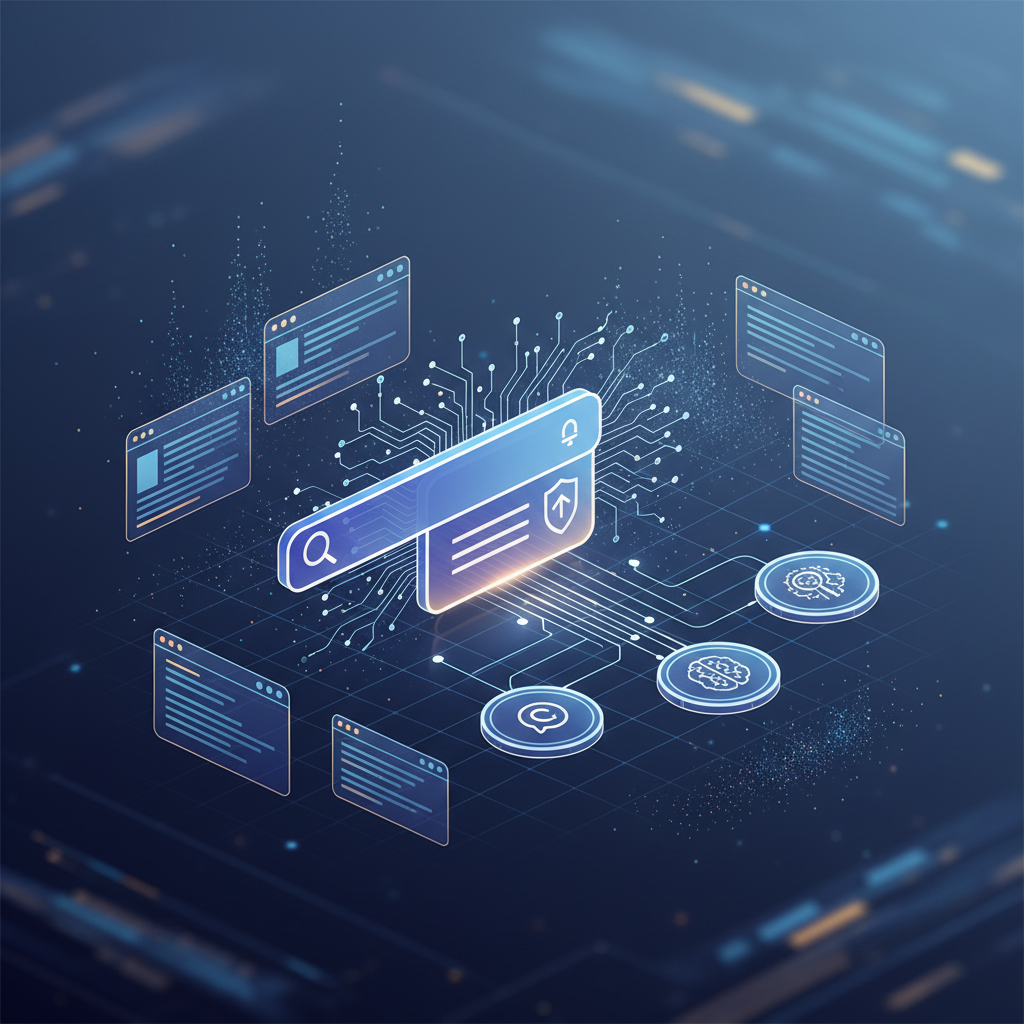
**When AI becomes the front door to your business**
A quiet shift is happening in search, and it’s already changing how buyers find (and trust) new vendors.
Instead of scrolling through ten blue links, more people now ask ChatGPT, Perplexity, or Google’s AI Overviews a question like:
“Who’s the best provider for X?”
“What’s the safest way to do Y?”
“What should we look for in a partner for Z?”
And then they act on the answer they’re given.
That’s the new “first impression.” And it’s why **AI visibility** is quickly becoming a growth lever—not a tech curiosity.
What’s changing (in plain terms)
Traditional SEO was built around keywords and rankings.
But in **AI-powered search**, the engine often *summarizes the market* and *recommends options*—sometimes without the user ever clicking through to a website.
That means discovery is no longer only about being the top result.
It’s about being the source the AI uses when it generates the answer.
This is where **Generative Engine Optimization (GEO)** comes in. GEO is the practice of improving how well AI systems can:
- Understand what your business does
- Trust what you claim
- Cite your content when answering questions
- Connect your expertise to the buyer’s intent
In other words: SEO helped people find your pages. GEO helps AI understand your business well enough to bring you into the conversation.
Why it matters to business growth
If you sell a service, you’re in a trust business.
Most buyers aren’t searching for “best vendor” only. They’re searching for confidence:
- “Is this approach proven?”
- “What will this cost us if it goes wrong?”
- “How long does implementation take?”
- “What questions should I ask in a demo?”
AI tools are increasingly the place where those questions get answered.
So if your company isn’t present inside those AI-generated answers, a competitor can win mindshare before your prospect even lands on your site.
And if your company *is* present, the upside is real:
**More qualified inbound traffic:** People arrive with context and intent, not casual curiosity.
**Higher trust and credibility:** Being cited or reflected in AI answers feels like a third-party endorsement.
**Better conversion rates:** Prospects come pre-educated, with clearer requirements and fewer basic questions.
**Staying competitive:** As search becomes AI-driven, the businesses with strong digital authority will get recommended more often.
This isn’t “the future.” It’s already happening in B2B buying cycles—especially for higher-consideration decisions where people want quick, confident guidance.
The uncomfortable truth: good companies can still be “invisible”
We see this often:
A company has strong results, great clients, and a capable team—but their website doesn’t clearly communicate expertise in a way machines can use.
To an AI system, many sites look like:
- Vague service pages
- Repeated marketing claims
- Thin case studies without details
- Missing structure, missing context, missing proof
If AI can’t confidently interpret what you do and who you do it for, it won’t surface you when someone asks.
That’s not about “gaming algorithms.” It’s about clarity.
RocketSales insight: AI visibility is becoming a website strategy issue
At RocketSales, we help companies build **digital authority** and measurable **AI visibility** through a mix of **AI consulting**, implementation, and ongoing optimization.
The goal is simple: when decision-makers use AI-powered search to research your category, your brand shows up as a credible option—because the AI has enough structured, expert-backed information to trust and reference you.
Here are a few practical moves that make the biggest difference (and that most businesses haven’t done yet):
1) **Publish expert-led content that AI engines can cite**
AI systems don’t “recommend” brands because the homepage says “we’re trusted.” They pull from content that demonstrates expertise: clear explanations, tradeoffs, best practices, and decision frameworks.
The winning content often looks like what your top salesperson explains on a call—written down and organized.
2) **Structure key pages so AI can understand your services clearly**
Many service pages are written like brochures. For GEO, they need to read more like a clear map: what the service is, who it’s for, what outcomes it drives, how engagement works, typical timelines, constraints, and what “good” looks like.
When content is structured well, AI can extract accurate summaries—and prospects can self-qualify faster.
3) **Add schema/metadata for machine readability**
Search engines and AI systems rely on signals. Schema and metadata help confirm what a page represents (service, organization, FAQ, review, case study, etc.).
This is foundational for GEO: it reduces ambiguity and improves the chance your content gets interpreted correctly.
4) **Align content with decision-maker search intent (not just keywords)**
A CFO, an operations leader, and a technical buyer ask different questions—even when they’re buying the same solution.
GEO works best when you build content around real decision moments: budgeting, risk, implementation, vendor evaluation, and outcomes. That alignment is what drives inbound leads that convert.
What to do next (if you want to stay ahead)
If your growth relies on inbound discovery—even partially—it’s worth auditing your current presence through an AI-first lens:
- When someone asks AI tools “who should I hire for X,” do you show up?
- If you do show up, is the summary accurate and compelling?
- Are you being cited for the topics you want to own?
- Does your website make it easy for both humans *and machines* to understand your offer?
Traditional SEO isn’t going away. But it’s no longer the whole game.
The new goal is being discoverable, understandable, and trusted inside the AI answers your buyers are already using.
If you want help building your GEO roadmap and improving AI visibility with a practical website strategy, RocketSales can help.
Learn more: https://getrocketsales.org
FAQ: Generative Engine Optimization (GEO)
What is GEO?
GEO (Generative Engine Optimization) is the practice of structuring your site so AI search engines can understand your expertise and cite your content in answers.
How is GEO different from SEO?
SEO is about rankings in search results. GEO is about being referenced directly inside AI-generated answers and summaries.
Does GEO help inbound leads?
Often yes — AI-driven discovery can bring fewer visits, but they’re typically higher-intent and closer to a buying decision.
About RocketSales
RocketSales is an AI consulting firm focused on Generative Engine Optimization (GEO) and AI-first discovery, helping businesses improve visibility inside AI-powered search tools and drive more qualified inbound leads.
Learn more at RocketSales:
https://getrocketsales.org