**When AI becomes the front door to your business**
A quiet shift is happening in how buyers find vendors.
A quiet shift is happening in how buyers find vendors.
They aren’t starting with a list of blue links anymore. They’re starting with an answer.
In ChatGPT. In Perplexity. In Google AI Overviews.
And that changes what it means to be “discoverable.”
If an AI-powered search experience summarizes the market and names 2–4 credible options, the question for most businesses becomes simple:
Are you one of the options it mentions… or are you invisible?
What’s changing (and why it matters)
Traditional SEO focused heavily on ranking pages for keywords. It was about getting the click.
Now, AI search often *skips the click*.
A buyer asks, “What’s the best warehouse management software for mid-sized manufacturers?” or “How do I reduce churn in a B2B subscription business?” The AI returns a short set of recommendations, common pricing models, key features to look for, and sometimes even a suggested shortlist of providers.
That means your website isn’t just competing for position on a results page.
It’s competing for **inclusion inside the answer**.
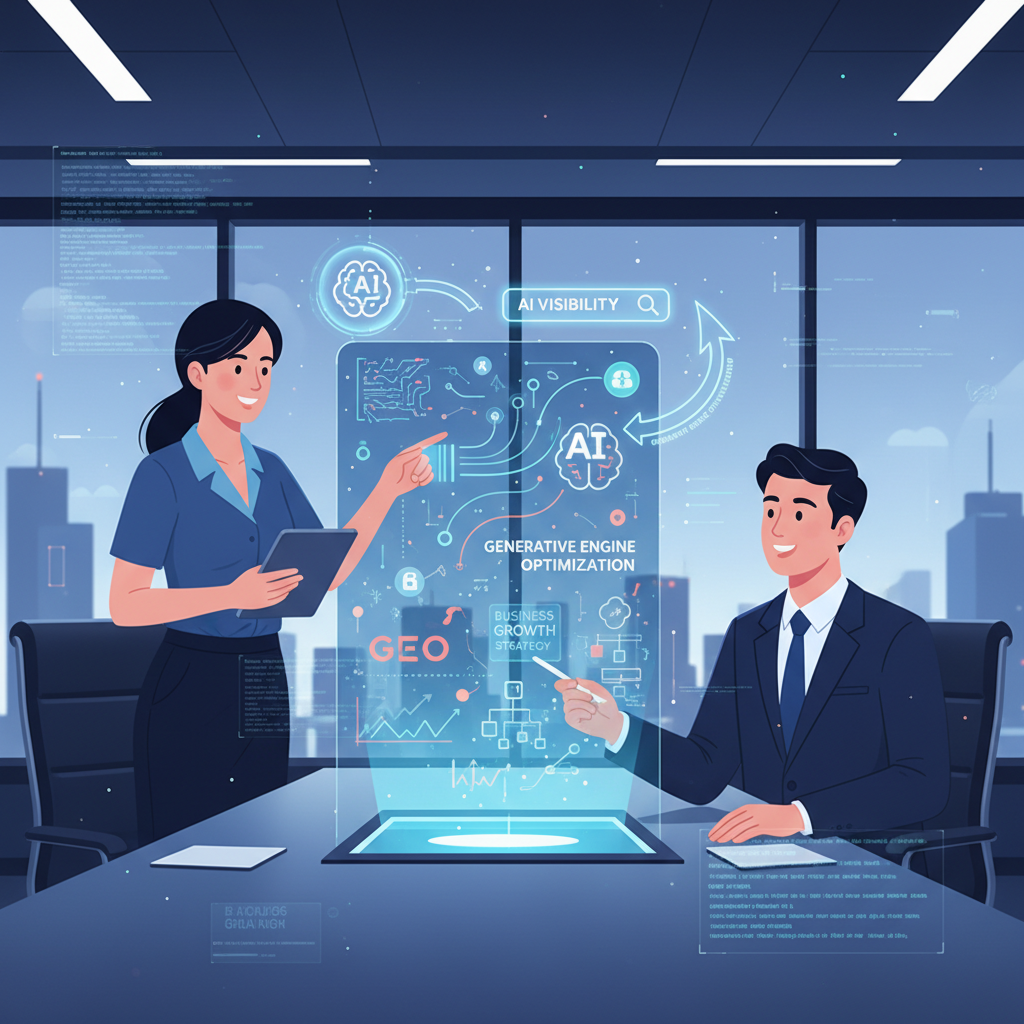
This is where **AI visibility** comes in—and why **Generative Engine Optimization (GEO)** is quickly becoming the next evolution beyond SEO. GEO is about helping AI systems understand your expertise, your services, and your credibility well enough to cite you accurately.
For businesses, the impact is real:
**1) More qualified inbound traffic**
When AI tools reference your business, the people who do click through arrive with higher intent. They’ve already been “pre-sold” on the category and often on the fit.
**2) Higher trust and credibility**
Being cited or recommended by an AI assistant functions like a new kind of third-party validation. It’s not the same as a testimonial—but it creates similar confidence: “This company seems established in this space.”
**3) Better conversion rates**
If your content answers real decision-maker questions and your site clearly explains what you do, visitors move faster from curiosity to conversation.
**4) Staying competitive as search becomes AI-driven**
If your competitors become the “default answer” inside ChatGPT or Google AI Overviews, they won’t just win traffic—they’ll win mindshare.
The hidden problem: AI can’t recommend what it can’t understand
Many websites look fine to humans but unclear to machines.
A service page might say: “We deliver end-to-end solutions tailored to your needs.” That reads nicely, but it doesn’t tell an AI engine:
- What specific service you provide
- Who it’s for
- What outcomes you drive
- How you’re different
- What proof supports your claims
AI systems need clarity, structure, and evidence. Without it, they hedge, generalize, or pick someone else who is easier to interpret.
In other words: strong design doesn’t equal strong digital authority.
What RocketSales sees in the market
At RocketSales, we’re seeing a consistent pattern: businesses investing in content, ads, and SEO—but still not showing up in AI-powered search results in a meaningful way.
Not because they aren’t good.
Because their website strategy wasn’t built for how AI engines read, summarize, and cite information.
That’s why we focus on **GEO** and **AI consulting** that connects visibility to revenue. Not vanity metrics. Not “more content” for the sake of it. The goal is to help your company become a trusted source that AI engines confidently reference—so you can generate more qualified **inbound leads**.
Practical takeaways you can apply this quarter
If you want better AI visibility, you don’t need to “hack” anything. You need to make your expertise easier to detect, trust, and reuse.
Here are a few practical moves that tend to create momentum quickly:
1) **Publish expert-led content that AI engines can cite**
AI tools look for clear explanations, definitions, comparisons, and step-by-step guidance. Content that works well often includes:
– “What it is / who it’s for / when to use it” framing
– Real-world examples and use cases
– Specific metrics, benchmarks, or decision criteria
– Clear language that a buyer would repeat in a meeting
If your content reads like a brochure, AI will treat it like a brochure. If it reads like expertise, AI is more likely to treat it like a source.
2) **Structure your service pages so machines can understand them**
A strong service page isn’t just persuasive—it’s unambiguous.
At minimum, each core service should clearly answer:
– What the service is (in one sentence)
– The outcomes you deliver
– The industries or customer types you serve
– Your process (simple, high-level steps)
– Proof (case studies, results, credible references)
This improves human conversions and helps AI-powered search systems accurately categorize what you do.
3) **Add schema/metadata for machine readability**
Schema is a type of structured data that helps machines interpret your content. Think of it like labeling the shelves in a warehouse so items are easier to find.
Depending on your business, this might include structured data for:
– Organization details
– Services
– FAQs
– Articles and authorship
– Reviews or case studies (when appropriate and compliant)
Done right, it supports digital authority and reduces the odds of AI misunderstanding your offering.
4) **Align content with decision-maker search intent**
A lot of content targets early-stage curiosity but ignores the questions that actually lead to purchase decisions.
Decision-makers search differently. They ask about:
– Total cost and pricing models
– Risks and implementation timelines
– ROI and business outcomes
– Vendor comparisons and tradeoffs
– “Best for…” scenarios by company size or industry
When you answer these directly, you don’t just attract traffic—you attract the right conversations.
Where RocketSales fits
RocketSales helps businesses grow through stronger AI visibility by combining strategy with implementation.
That typically includes:
– Auditing how your brand appears (or doesn’t) in AI-powered search
– Identifying the topics, pages, and proof points that AI systems need to trust you
– Building a GEO-driven website strategy that supports both citations and conversions
– Implementing structured content and technical improvements so your expertise is machine-readable
– Optimizing over time as AI search experiences change
The result is more than “rankings.” It’s stronger digital authority that can translate into higher-quality inbound leads and better sales efficiency.
If your buyers are using ChatGPT, Perplexity, or Google AI Overviews to shortlist vendors, AI visibility is no longer optional—it’s part of your go-to-market.
If you want to see where you stand and what to prioritize, RocketSales can help:
https://getrocketsales.org
FAQ: Generative Engine Optimization (GEO)
What is GEO?
GEO (Generative Engine Optimization) is the practice of structuring your site so AI search engines can understand your expertise and cite your content in answers.
How is GEO different from SEO?
SEO is about rankings in search results. GEO is about being referenced directly inside AI-generated answers and summaries.
Does GEO help inbound leads?
Often yes — AI-driven discovery can bring fewer visits, but they’re typically higher-intent and closer to a buying decision.
About RocketSales
RocketSales is an AI consulting firm focused on Generative Engine Optimization (GEO) and AI-first discovery, helping businesses improve visibility inside AI-powered search tools and drive more qualified inbound leads.
Learn more at RocketSales:
https://getrocketsales.org