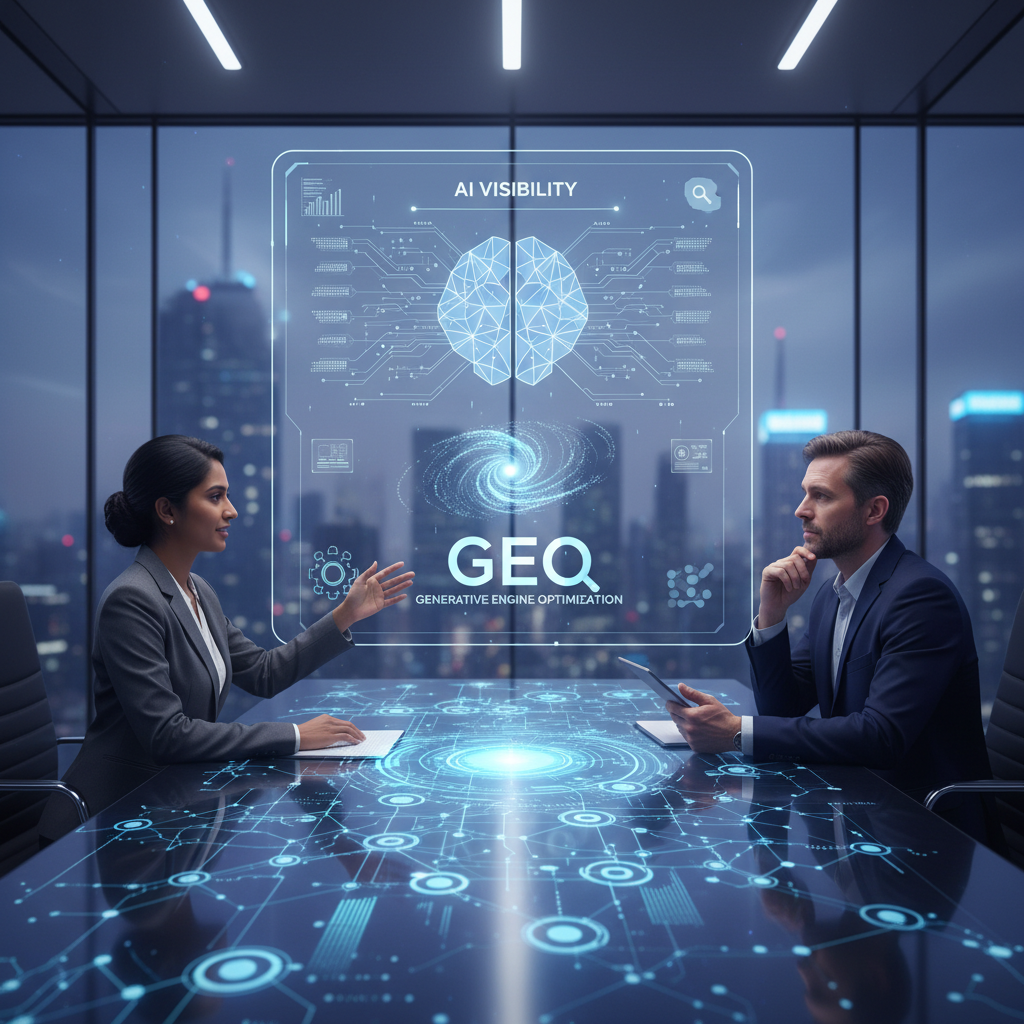
**Google SEO isn’t dead—it’s being rewritten by AI**
For years, the playbook was simple: rank on Google, win clicks, capture leads.
For years, the playbook was simple: rank on Google, win clicks, capture leads.
Now Google is answering the question *for* the user.
With Google AI Overviews (and tools like ChatGPT and Perplexity), buyers increasingly get a “compiled” answer at the top of the page—often without needing to visit ten different websites. That’s a major shift in how businesses get discovered, evaluated, and trusted online.
This is where **AI visibility** becomes a real business advantage, not a marketing buzzword.
What’s changing in search (and why it matters)
Traditional SEO focused on keywords, backlinks, and getting to page one.
AI-powered search changes the goalpost. Instead of only ranking links, these engines:
- Summarize topics
- Compare vendors
- Recommend next steps
- Cite sources (sometimes)
- Pull facts, definitions, and positioning from your site
In other words, AI doesn’t just *list* your website. It can *speak for your brand*.
That’s great when the AI is pulling clear, accurate info from your pages.
It’s a problem when the AI can’t understand what you do, who you serve, or why you’re different—so it cites competitors or generic sources instead.
For businesses, this shift impacts three big outcomes:
**1) More qualified inbound traffic**
When AI tools recommend you (or cite your insights), the visitors who do click through are often further along in the buying process. They’re not just browsing—they’re validating.
**2) Higher trust and credibility**
Being cited or summarized in AI-powered search builds authority fast. It’s the digital version of “a third party recommended them.”
**3) Better conversion rates**
AI-driven visitors tend to arrive with clearer intent: “I need a solution like this,” not “I’m vaguely researching.”
And if your competitors become the default recommendations inside AI, it gets harder—and more expensive—to win attention through ads or generic content.
The rise of GEO: the next evolution beyond SEO
This is where **Generative Engine Optimization (GEO)** comes in.
GEO is the practice of helping AI systems understand, trust, and surface your brand in generative answers—across Google AI Overviews, ChatGPT-style experiences, and other AI-powered search tools.
It’s not a replacement for SEO. It’s the next layer.
Think of it like this:
- SEO helps you get discovered as a link.
- GEO helps you get discovered as an answer.
That difference matters because buyers are increasingly searching in ways that sound like:
- “Best X software for mid-sized manufacturing”
- “Compare Y vs Z for a 50-person finance team”
- “What’s the right approach to implement AI in operations?”
- “Who are the top providers in [industry]?”
AI engines don’t just match keywords. They look for **meaning**, **clarity**, **proof**, and **authority**.
The hidden risk: your website may be “ranked” but not “understood”
Many business websites were built for human browsing and keyword SEO, not for AI interpretation.
Common issues we see:
Short service pages that say a lot of general things but few concrete details.
No clear description of your ideal customer, use cases, or outcomes.
Content that’s heavy on marketing language and light on expertise.
Missing structure that helps machines interpret the page (headings, consistent sections, schema/metadata).
So even if you’re doing “fine” in traditional rankings, AI may still struggle to confidently reference you.
And when AI isn’t confident, it defaults to other sources.
RocketSales insight: how we help companies win AI visibility
At RocketSales, we focus on **AI consulting** and implementation that improves your visibility where buyers are increasingly making decisions: inside AI-generated results.
We help companies build **digital authority** in a way AI engines can actually use—so your expertise becomes easier to cite, summarize, and recommend.
Here are a few practical takeaways you can apply right now as part of your **website strategy**:
**1) Publish expert-led content that AI engines can cite**
AI models look for content that reads like it came from a real operator: specific, detailed, and grounded in experience.
If your content only says “We provide best-in-class solutions,” it won’t stand out. If it explains “Here’s how we reduce onboarding time by 30% and what that changes operationally,” it becomes reference-worthy.
**2) Structure your service pages for clarity, not just design**
A strong service page should make it obvious—within seconds—what you do, who it’s for, and what outcomes you drive.
Clear headings, direct language, and consistent sections (problems, approach, deliverables, results, FAQs) help both buyers and AI-powered search understand you.
**3) Add schema/metadata so machines can read your site correctly**
Schema is like labeling the shelves in a store. It helps AI interpret what a page is: a service, a product, a company, a review, an FAQ, a location, and more.
Many sites skip this, which is like handing AI a book with no table of contents.
**4) Align content with decision-maker intent, not just top-of-funnel traffic**
Operations leaders and business owners don’t search the same way entry-level researchers do. They ask: cost, timeline, risk, proof, and fit.
When your content answers those questions directly, you attract better **inbound leads** and shorten sales cycles.
None of this requires “gaming the algorithm.” It’s about making your business easier to understand and trust—by humans *and* by AI systems.
What to do next
If your growth depends on inbound, your brand can’t afford to be invisible in AI-generated answers.
The companies that win the next phase of search will be the ones that:
- communicate clearly,
- prove expertise,
- and build content AI can confidently summarize.
If you want help improving **AI visibility** through **Generative Engine Optimization (GEO)**, RocketSales can help you assess where you stand and what to fix first.
Learn more here: https://getrocketsales.org
FAQ: Generative Engine Optimization (GEO)
What is GEO?
GEO (Generative Engine Optimization) is the practice of structuring your site so AI search engines can understand your expertise and cite your content in answers.
How is GEO different from SEO?
SEO is about rankings in search results. GEO is about being referenced directly inside AI-generated answers and summaries.
Does GEO help inbound leads?
Often yes — AI-driven discovery can bring fewer visits, but they’re typically higher-intent and closer to a buying decision.
About RocketSales
RocketSales is an AI consulting firm focused on Generative Engine Optimization (GEO) and AI-first discovery, helping businesses improve visibility inside AI-powered search tools and drive more qualified inbound leads.
Learn more at RocketSales:
https://getrocketsales.org