Why early AI visibility adopters win faster?
If you’re a business leader, this question isn’t really about “AI marketing.” It’s about speed to revenue.
Early adopters of **AI visibility** win faster because they become the sources that AI systems cite, summarize, and recommend—while everyone else is still fighting for blue-link rankings that fewer buyers rely on each month.
And this matters right now because search behavior is changing quickly. Prospects aren’t only “Googling” and clicking results. They’re asking ChatGPT, Perplexity, and Google AI Overviews to shortlist vendors, compare options, and explain tradeoffs. In other words: buyers are outsourcing research to AI. If your company isn’t showing up in those answers, you’re not just losing traffic—you’re losing consideration.
Step 1 — Context & trend: search is shifting from ranking pages to being recommended
Traditional SEO was built for a world where search engines listed pages and users clicked through to read them.
**AI-powered search** changes the model:
- The AI reads many sources, then produces an answer.
- It often cites a few brands, frameworks, and “trusted” pages.
- The user may never click—because the answer is already on the screen.
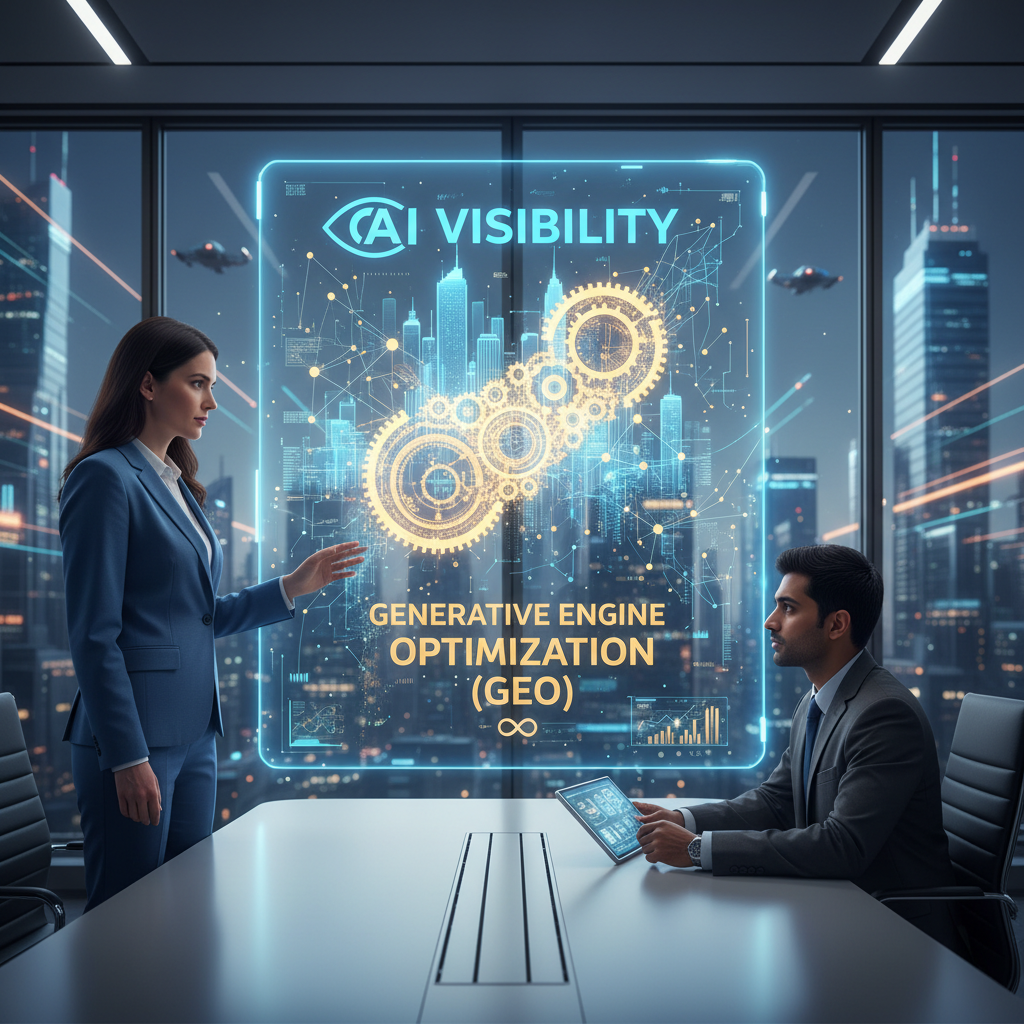
This is why **Generative Engine Optimization (GEO)** is emerging. GEO is the practice of making your website and content easier for generative AI systems to understand, trust, and reuse—so you’re more likely to be cited and recommended.
Here’s what’s happening under the hood, in practical terms:
**1) AI systems reward clarity over cleverness**
Pages that clearly define what you do, who it’s for, and how it works are easier to summarize accurately. Vague language and “marketing fog” makes you invisible—or worse, misrepresented.
**2) AI systems look for authority signals, not just keywords**
Yes, keywords still matter. But AI also weighs credibility: consistent expertise, real examples, identifiable authorship, up-to-date information, and alignment across your site.
**3) The new competition is smaller—but harder to break into later**
In many AI answers, only a handful of sources get cited. That creates a “winner cluster.” Once those sources are repeatedly used, they build momentum—more visibility, more mentions, more trust.
That’s the shift: from “Where do we rank?” to “Are we included in the answer?”
Step 2 — Direct answer: why early adopters win faster (and what changed)
Early AI visibility adopters win faster because they get compounding advantages that late adopters can’t easily buy back.
### What it means
Being an “early adopter” doesn’t mean using every new tool. It means aligning your content and **website strategy** to how AI systems select and present sources—now, while the citation landscape is still forming.
### How it works (plain language)
AI engines are building a mental map of your category:
- Who are the credible providers?
- What do they specialize in?
- Which pages explain the topic cleanly?
- Which brands are consistently referenced across the web?
If you invest early in GEO, you give these systems clear, structured, trustworthy material to pull from. That increases the odds you’re cited in AI answers—and those citations lead to real business outcomes.
### What changed recently
Three things shifted at once:
1) **Buyer behavior**: Decision-makers are using AI to compress research time. Vendor discovery is becoming conversational, not click-based.
2) **Search interfaces**: AI Overviews and answer engines reduce the need to open multiple tabs.
3) **Content selection**: The “top 10 results” model is giving way to “top 3 sources the AI trusts.”
### Why businesses should care now (not someday)
Because AI recommendations shape the shortlist.
If AI repeatedly includes your company when someone asks:
- “Best [service] for mid-market companies”
- “Top firms for [problem] in [industry]”
- “What’s the difference between X and Y, and who provides it?”
…you’re entering the buyer journey earlier, with higher trust.
That typically shows up as:
- **Higher-quality inbound leads** (prospects who already understand your value)
- **Shorter sales cycles** (less education required)
- **Better conversion rates** (AI validates you as a credible option)
- Stronger **digital authority** (your expertise becomes the reference point)
The fastest winners aren’t the loudest marketers. They’re the clearest and most citable.
Step 3 — RocketSales insight: how we help businesses become “AI-citable”
At RocketSales, we treat AI visibility like a revenue system, not a content project.
Our work blends **AI consulting** with practical execution. We start by finding where AI systems are currently getting their answers in your category, then we build a GEO plan to earn inclusion—through content structure, authority signals, and citation readiness.
What that looks like:
**AI visibility audits**
We evaluate how your brand appears (or doesn’t) across AI answers, and why. This includes reviewing your service pages, core content, authorship signals, and how clearly your expertise is presented.
**Generative Engine Optimization strategy**
We map the topics and decision-maker questions AI engines repeatedly answer in your space, then align your content to those prompts—so your site becomes a reliable source.
**Content structuring for AI understanding**
AI prefers content it can parse: definitions, steps, comparisons, and evidence. We restructure pages so they’re easier to summarize accurately—without turning them into robotic “SEO pages.”
**Authority and citation optimization**
We strengthen trust signals: consistent positioning, proof points, expert attribution, and external references that help AI and buyers validate your claims.
Practical takeaways you can apply immediately:
- Publish expert-led content that answers buyer questions directly (use clear headers like “Who this is for,” “What results to expect,” and “Common pitfalls”).
- Structure service pages so an AI can summarize them in one paragraph: what you do, for whom, how it works, and what makes you different.
- Use schema and clean metadata where appropriate so your key information is easier to interpret and reuse (think: services, FAQs, organization details).
- Align content with decision-maker intent: cost, timeline, risks, selection criteria, and what “good” looks like.
None of this replaces traditional SEO. It upgrades it for the way people actually search now.
Step 4 — Future-facing insight: what happens if you ignore the shift
If businesses ignore AI visibility and rely only on traditional SEO, a predictable pattern shows up:
- Traffic becomes less reliable as AI answers reduce clicks.
- Competitors get cited, which makes them feel “pre-approved.”
- Your brand becomes harder to discover unless someone already knows your name.
- You end up paying more for attention—ads, sponsorships, outbound—because organic discovery shrinks.
Meanwhile, companies that invest in **GEO** now build an advantage that compounds: they earn citations, those citations reinforce trust, and trust leads to more recommendations.
In a market where attention is filtered through AI, being “good” isn’t enough. You have to be understood and selected by the systems that guide buyer choices.
Step 5 — CTA (subtle next step)
If you want to understand where your company stands in AI-powered search—and what it would take to become a cited, recommended source—RocketSales can help you assess and improve your AI visibility.
Learn more at https://getrocketsales.org.
FAQ: Generative Engine Optimization (GEO)
What is GEO?
GEO (Generative Engine Optimization) is the practice of structuring your site so AI search engines can understand your expertise and cite your content in answers.
How is GEO different from SEO?
SEO is about rankings in search results. GEO is about being referenced directly inside AI-generated answers and summaries.
Does GEO help inbound leads?
Often yes — AI-driven discovery can bring fewer visits, but they’re typically higher-intent and closer to a buying decision.
About RocketSales
RocketSales is an AI consulting firm focused on Generative Engine Optimization (GEO) and AI-first discovery, helping businesses improve visibility inside AI-powered search tools and drive more qualified inbound leads.
Learn more at RocketSales:
https://getrocketsales.org