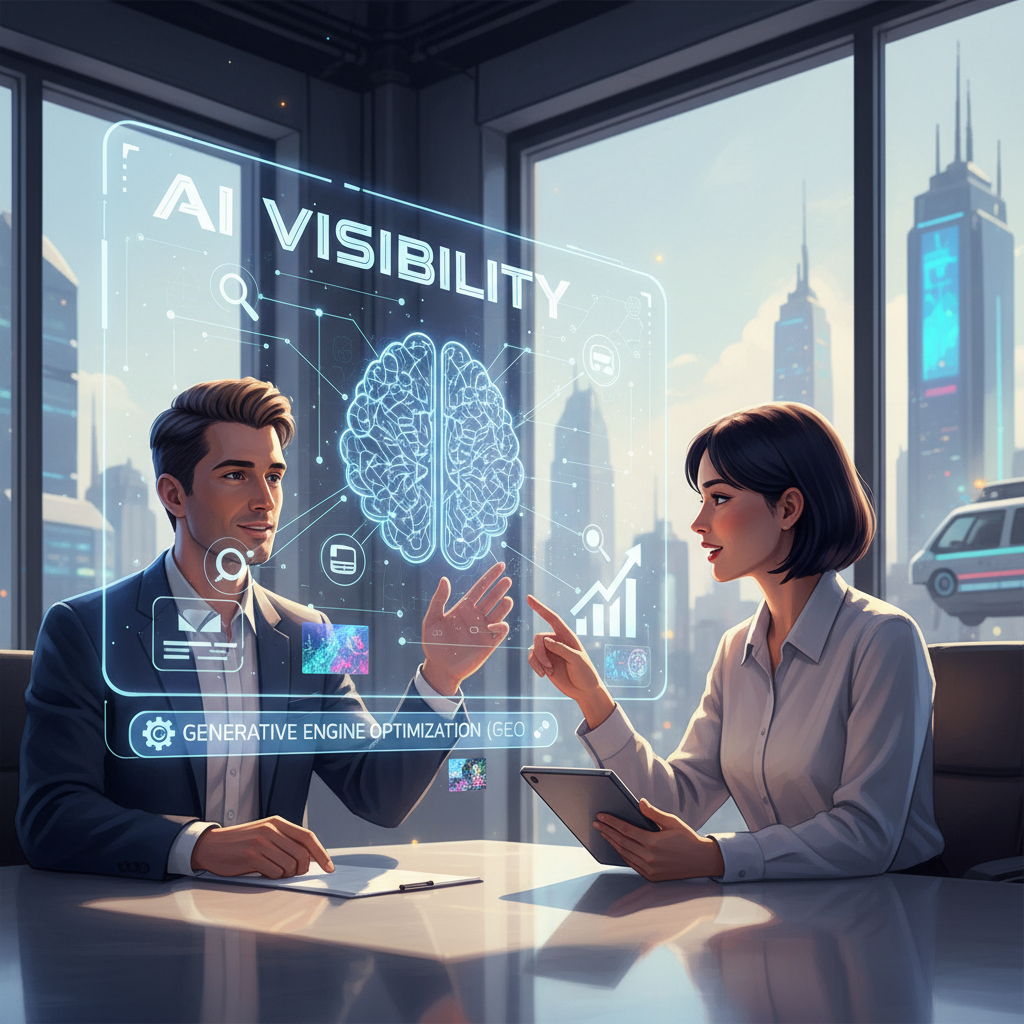
**Your SEO still matters. But AI visibility is now the new front door.**
For years, most website strategy revolved around one goal: rank on Google for the right keywords.
That’s still important. But something big has changed in how people discover vendors, compare options, and make decisions.
Buyers are now using **AI-powered search**—tools like ChatGPT, Perplexity, and Google AI Overviews—to get answers fast. Instead of clicking through ten blue links, they often ask one question and trust the summarized response.
If your company isn’t showing up in those answers, you can have a great website and still be invisible at the exact moment a buyer is ready to shortlist options.
That’s where **AI visibility** and **Generative Engine Optimization (GEO)** come in.
What’s happening right now (and why it matters)
Google AI Overviews are expanding. Chat-based search is becoming normal. And “research” is shifting from browsing websites to asking AI for a recommendation.
Here’s the key difference:
Traditional SEO was about getting a click.
GEO is about being *included*—being cited, summarized, or referenced by the AI systems that buyers trust.
That shift matters because it changes the path to revenue.
When an AI engine answers a question like “best inventory forecasting software for mid-market manufacturers” or “how to choose a cybersecurity partner for a healthcare group,” it doesn’t pull from every website equally.
It tends to favor content that is:
Clear and specific
Well-structured
Consistent across your site
Credible and grounded in expertise
In other words, it favors businesses that have built real **digital authority**, not just pages stuffed with keywords.
If you’re not optimizing for that new reality, you’re likely seeing these symptoms already:
Your rankings may look fine, but traffic is flat or declining.
Prospects show up more “educated,” but mention sources you didn’t influence.
Competitors with weaker offerings seem to be “everywhere” in conversations.
This is the new search funnel. And it’s happening faster than most businesses expected.
The business impact: fewer clicks, but higher intent
One of the most misunderstood parts of this trend is the fear that “AI will kill website traffic.”
Yes, some top-of-funnel clicks will shrink. But what replaces them can be more valuable.
When your brand is referenced in an AI answer, you’re not just getting exposure. You’re getting *pre-qualified attention*.
You’re showing up inside a moment where the buyer is:
Defining requirements
Comparing options
Looking for proof and credibility
Trying to reduce risk
That’s why improving AI visibility can lead to:
More qualified inbound traffic (even if total traffic is lower)
Higher trust, because the recommendation feels “third-party”
Better conversion rates, because buyers arrive with context
A real competitive edge as AI becomes the default research tool
If your website is your digital sales rep, GEO is how you train it to speak clearly in AI-driven conversations.
SEO + GEO: it’s not either/or
This isn’t “SEO is dead.” It’s “SEO alone is no longer enough.”
SEO helps you earn discoverability through rankings.
GEO helps you earn discoverability through answers.
Both rely on strong content, but GEO adds an extra requirement: your content must be easy for machines to interpret, extract, and confidently reuse.
That means the winners won’t be the companies publishing the most content.
They’ll be the companies publishing the clearest content—written for humans, structured for AI, and aligned with how decision-makers actually search.
RocketSales insight: how we help companies become findable in AI search
At RocketSales, we focus on **AI consulting** and hands-on implementation to improve AI visibility across the systems buyers now trust.
Our work is practical: we help you earn a stronger presence in AI-powered search while strengthening the foundation that supports traditional SEO.
Here are a few takeaways you can apply right away (and where we often start with clients):
1) **Publish expert-led content that AI engines can cite**
AI tools tend to prefer content that sounds like it comes from real experience—clear opinions, real-world examples, defined processes, and strong explanations.
If your website only has vague service pages, AI will struggle to “quote” you.
2) **Structure your key pages so AI can understand your services**
Many websites are written like brochures: lots of nice language, not enough meaning.
Strong GEO pages are specific: who you help, what you do, how it works, what results look like, and what makes you different—without fluff.
3) **Add schema and metadata for machine readability**
This is a simple but often ignored part of modern website strategy. Schema helps search engines interpret your pages (what’s a service, what’s a location, what’s a FAQ, who authored an article).
It’s not glamorous, but it helps your content get indexed and understood more reliably.
4) **Align content with decision-maker search intent**
Leaders don’t search the way marketers think they do. They ask questions tied to risk, cost, timeline, and outcomes.
When your content mirrors those questions—and answers them directly—you don’t just get found. You get trusted.
These actions compound. Over time, they increase your digital authority so you’re not fighting for attention with every new post. You’re building a presence that AI engines return to again and again.
The bottom line
AI is becoming the first filter between your company and your future customers.
If you want stronger inbound leads in 2026 and beyond, you need to be visible not just on Google’s results page, but inside the answers people are now relying on.
That’s what **Generative Engine Optimization (GEO)** is really about: making sure your expertise is discoverable, understandable, and worth citing—where modern buyers are searching.
If you’re curious how your website currently performs in AI-powered search (and what to fix first), RocketSales can help.
Learn more here: https://getrocketsales.org
FAQ: Generative Engine Optimization (GEO)
What is GEO?
GEO (Generative Engine Optimization) is the practice of structuring your site so AI search engines can understand your expertise and cite your content in answers.
How is GEO different from SEO?
SEO is about rankings in search results. GEO is about being referenced directly inside AI-generated answers and summaries.
Does GEO help inbound leads?
Often yes — AI-driven discovery can bring fewer visits, but they’re typically higher-intent and closer to a buying decision.
About RocketSales
RocketSales is an AI consulting firm focused on Generative Engine Optimization (GEO) and AI-first discovery, helping businesses improve visibility inside AI-powered search tools and drive more qualified inbound leads.
Learn more at RocketSales:
https://getrocketsales.org