**Google Search is becoming an answer engine—here’s what that means for your business**
A quiet shift is happening in search.
A quiet shift is happening in search.
For years, the goal was simple: rank on page one of Google. If you won the keyword game, you earned the click.
Now, buyers are getting answers without clicking.
Google AI Overviews summarize results at the top of the page. Tools like ChatGPT and Perplexity can recommend vendors, outline options, and even suggest “best providers” based on what they can find and trust online.
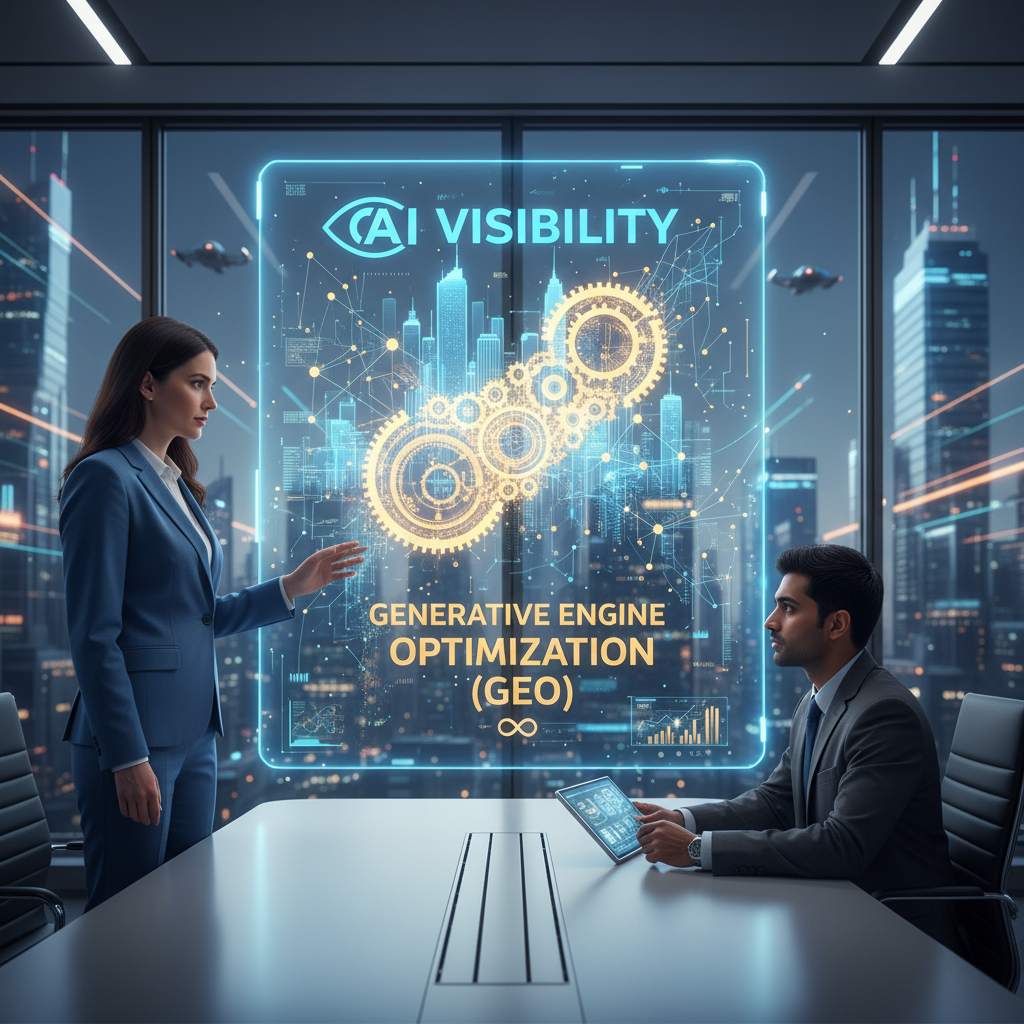
This is the new battleground: **AI visibility**.
And it’s changing what “good SEO” really means.
The trend: from keywords and clicks to citations and trust
Traditional SEO focused on matching keywords, earning backlinks, and optimizing pages to get traffic.
That still matters—but it’s not the full picture anymore.
In **AI-powered search**, the engine isn’t just listing websites. It’s trying to *understand* them. Then it generates an answer using sources it considers credible, clear, and easy to interpret.
So instead of asking:
“Can we rank for this keyword?”
Businesses now need to ask:
“Will an AI engine understand what we do, trust it, and cite it?”
That shift is exactly why **Generative Engine Optimization (GEO)** is emerging as the next evolution beyond classic SEO. GEO is about making sure your company is discoverable and accurately represented inside AI-generated answers.
Why it matters: revenue will follow the companies AI can explain
This isn’t a “marketing trend.” It’s a buyer-behavior trend.
Decision-makers are using AI tools to speed up research:
- They ask for shortlists of vendors.
- They compare options in one prompt.
- They want clear proof, not fluff.
- They trust summaries when the sources look credible.
If your website isn’t structured in a way AI can interpret, you may still exist online—but you won’t be *chosen* in the moments that matter.
Here’s what this unlocks when done right:
**More qualified inbound traffic**
AI-generated answers tend to filter out noise. When someone clicks through after reading an overview or a ChatGPT summary, they often have higher intent.
**Higher trust and credibility**
Being cited or referenced (directly or indirectly) builds instant confidence. It’s similar to word-of-mouth, but at scale.
**Better conversion rates**
When the buyer already understands your offer before landing on your site, you spend less time educating and more time closing.
**Staying competitive as search becomes AI-driven**
Your competitors aren’t just fighting for rankings anymore. They’re fighting to become the “recommended answer.”
Where many companies get stuck
Most websites were built for humans first (good) and search engines second (okay). But AI systems need a third layer: clarity.
Common issues we see:
- Service pages are vague or full of buzzwords, so AI can’t confidently summarize what you do.
- Content is written to attract traffic, but not to answer decision-maker questions.
- The site lacks structured signals (like schema/metadata) that help machines interpret key facts.
- Thought leadership exists, but it isn’t organized in a way that makes it easy to cite.
The result: the company may rank decently, but it doesn’t show up in the places where AI-driven research happens.
That’s a visibility gap—and it often shows up later as a pipeline gap.
The RocketSales insight: GEO is a website strategy, not a blog schedule
At RocketSales, we approach **GEO** like a business system.
Because “being visible in AI” isn’t about posting more. It’s about building **digital authority** that AI engines can recognize and reuse.
As an **AI consulting** partner, RocketSales helps companies improve how they are discovered, summarized, and recommended across AI-powered search experiences—through strategy, implementation, and ongoing optimization.
That means we look at questions like:
- What does AI think your company does today?
- What sources does it use to form that opinion?
- What pages should be the “source of truth” for your core services?
- Where are the content gaps that prevent you from being included in shortlists?
Then we help teams fix the foundation, not just the surface.
Practical takeaways you can apply this quarter
If you’re trying to increase AI visibility without rebuilding everything, start here.
1) **Publish expert-led content that AI engines can cite**
AI tools favor clear, specific explanations over generic marketing copy. Create pages and articles that sound like your best internal experts: definitions, frameworks, comparisons, and “how to choose” guidance. The goal is to become a reliable reference, not just a vendor.
2) **Structure service pages so AI can understand them in seconds**
Make it easy for both buyers and machines to answer:
– What problem do you solve?
– Who is it for?
– What is your process?
– What outcomes do clients get?
– What makes you different?
If that isn’t obvious on the page, AI will fill in the blanks—or skip you.
3) **Add schema/metadata to improve machine readability**
You don’t need to be technical to care about this. Schema is like labeling the shelves in a store. It helps systems identify your services, locations, reviews, FAQs, and key entities. When AI systems can “read” your site more accurately, they’re more likely to use it.
4) **Align content with decision-maker search intent**
A lot of content is built for awareness, but not for action. Decision-makers search differently. They want risk reduction, proof, clarity on pricing drivers, timelines, and what success looks like. Build content around those real buying questions and your site becomes a lead generator, not just a brochure.
Each of these supports what every operations and revenue leader wants: more consistent, higher-quality **inbound leads** without depending entirely on ads or outbound.
The bottom line
Google SEO isn’t dead. It’s evolving.
The winners in the next phase won’t just rank—they’ll be the companies that AI can confidently explain, cite, and recommend.
That’s what **Generative Engine Optimization** is really about: turning your website into a trusted source in AI-powered search, so the right buyers find you earlier and move faster.
If you want help assessing where you stand—and what to fix first—RocketSales can help.
Learn more here: https://getrocketsales.org
FAQ: Generative Engine Optimization (GEO)
What is GEO?
GEO (Generative Engine Optimization) is the practice of structuring your site so AI search engines can understand your expertise and cite your content in answers.
How is GEO different from SEO?
SEO is about rankings in search results. GEO is about being referenced directly inside AI-generated answers and summaries.
Does GEO help inbound leads?
Often yes — AI-driven discovery can bring fewer visits, but they’re typically higher-intent and closer to a buying decision.
About RocketSales
RocketSales is an AI consulting firm focused on Generative Engine Optimization (GEO) and AI-first discovery, helping businesses improve visibility inside AI-powered search tools and drive more qualified inbound leads.
Learn more at RocketSales:
https://getrocketsales.org