**Your SEO isn’t broken. Search just changed.**
A lot of business leaders are noticing something odd in their analytics.
A lot of business leaders are noticing something odd in their analytics.
They’re still investing in Google SEO. They’re still publishing content. They’re still ranking for important terms.
But the leads feel softer. The traffic doesn’t convert like it used to. And more buyers seem to “already know” the shortlist before they ever fill out a form.
What’s happening isn’t a mystery—it’s an upgrade in how search works.
Google is no longer just a list of links. With Google AI Overviews, many searches now get an answer right on the results page. At the same time, more people are using AI-powered search tools like ChatGPT and Perplexity to research vendors, compare options, and decide what to do next.
And here’s the key shift:
If the AI doesn’t understand your business clearly, it can’t recommend you—even if your site looks great and your SEO used to perform.
That’s where AI visibility comes in.
The trend: buyers are asking AI to make the shortlist
Historically, search was a process:
1) Type a query
2) Click a few results
3) Read pages
4) Compare vendors
5) Reach out
Now, buyers are skipping steps 2–4.
They ask questions like:
- “What’s the best ERP for a mid-sized manufacturer?”
- “What’s a good alternative to [competitor] for healthcare?”
- “Which firm can implement AI automation for customer support?”
- “What should I look for in a cybersecurity provider?”
AI engines answer in paragraphs. They summarize. They compare. They cite sources.
That means your visibility is no longer only about where you rank.
It’s also about whether AI engines can:
- Understand what you do
- Trust what you say
- Cite your content
- Recommend you with confidence
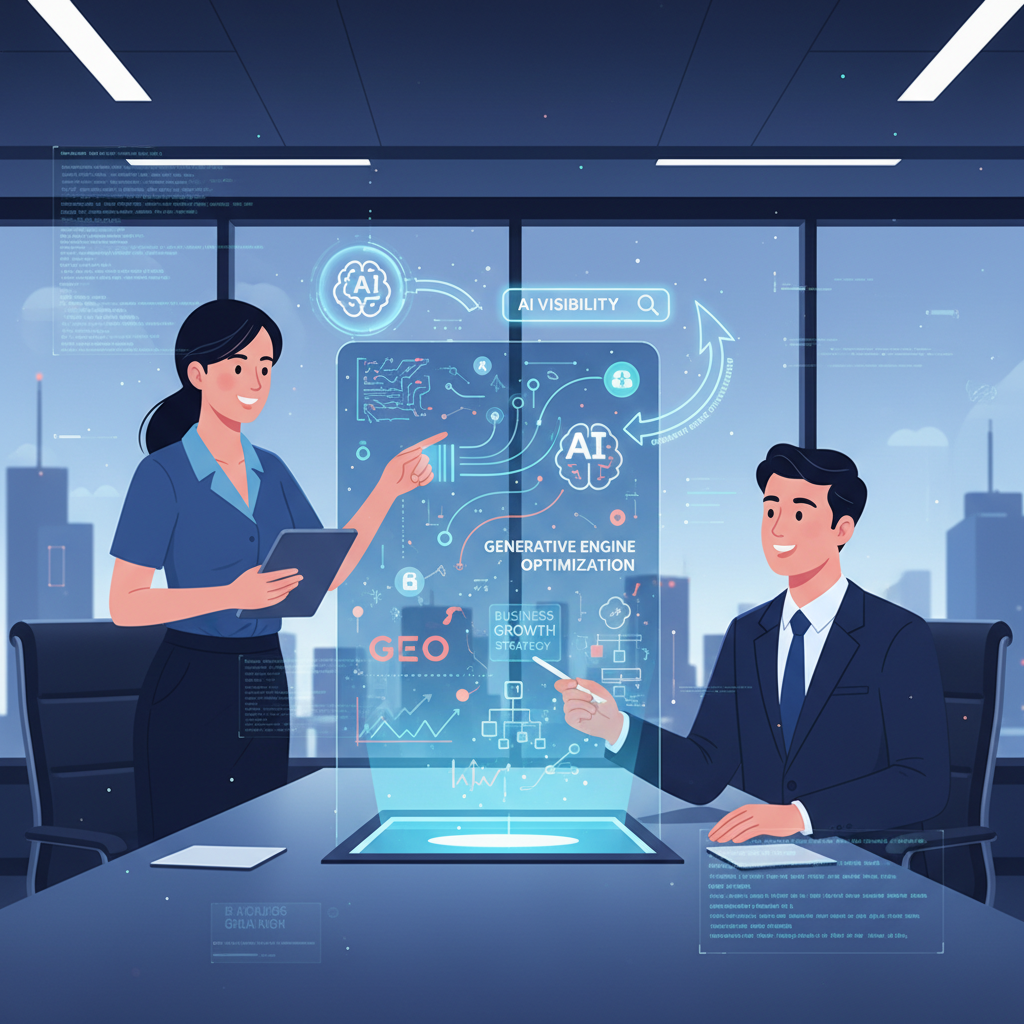
This shift is exactly why Generative Engine Optimization (GEO) is emerging as the next evolution beyond traditional SEO.
GEO is the practice of making your website and content easier for AI systems to interpret, trust, and reference—so you show up inside AI-generated answers, not just in blue links.
Why it matters: visibility is moving “upstream” of the lead
For most B2B businesses, inbound leads come after trust.
And AI is now part of how trust is formed.
If a buyer asks ChatGPT or Google AI Overviews for guidance and your company is not mentioned, you may never enter the evaluation set. Even if your solution is a perfect fit, you’re invisible at the moment the shortlist forms.
On the flip side, companies that earn strong digital authority in AI systems often see:
**More qualified inbound traffic**
Because the buyer arrives after consuming a summarized, high-intent answer.
**Higher trust and credibility**
Being cited or recommended by AI feels like a “third-party validation” moment.
**Better conversion rates**
The visitor isn’t browsing casually—they’re comparing and deciding.
**A competitive edge as search becomes AI-driven**
This is especially important in crowded markets where differentiation is hard.
In other words, SEO still matters. But it’s no longer the full game.
Website strategy now has to support both humans and machines.
Where most companies fall short
Many websites are written like marketing brochures:
- Vague service pages
- Generic value propositions
- Blog posts aimed at broad keywords
- Missing context (who it’s for, what problems it solves, what outcomes look like)
Humans can sometimes “read between the lines.”
AI can’t.
AI systems depend on clarity, structure, and consistent signals across your site. If your positioning is fuzzy, or your pages don’t clearly connect problems → solutions → proof, AI has little to work with.
And when AI has little to work with, it either ignores you or misrepresents you.
RocketSales insight: GEO is the bridge between SEO and AI visibility
At RocketSales, we help businesses improve AI visibility through AI consulting, hands-on implementation, and ongoing optimization.
Our approach blends modern SEO fundamentals with Generative Engine Optimization (GEO)—because ranking in Google is no longer the only finish line. Being understood and referenced in AI-powered search is quickly becoming the real advantage.
Here are a few practical takeaways you can apply right now:
1) **Publish expert-led content that AI engines can cite**
AI systems prefer content that sounds like it came from a real expert: clear claims, specific advice, concrete examples, and a point of view.
If your content is generic, AI will pull from someone else who is more precise.
2) **Structure service pages so machines understand them instantly**
A strong service page shouldn’t just “sell.” It should define:
– who the service is for
– what problems it solves
– what the process looks like
– what success metrics improve
This makes it easier for AI to match your offering to a buyer’s question.
3) **Use schema/metadata to improve machine readability**
Schema is a type of structured data that helps search engines and AI systems interpret your pages.
It won’t magically make weak content strong, but it can amplify clarity—especially for services, organizations, FAQs, reviews, and authorship.
4) **Align content with decision-maker search intent**
Most content targets early-stage questions. But decision-makers also ask:
– “What does implementation look like?”
– “How long does this take?”
– “What are common failure points?”
– “What does it cost and why?”
Answering these questions directly improves both conversion and AI visibility, because it mirrors how real buyers evaluate.
These aren’t “tricks.” They’re the basics of communicating clearly in an AI-first world.
The business takeaway: the new search winner is the clearest company
As AI-driven discovery grows, the companies that win won’t be the ones who publish the most content.
They’ll be the ones who explain their value the clearest, back it with credible proof, and structure it in a way that both people and AI can understand.
Traditional SEO helped buyers find you.
GEO helps AI recommend you.
If you’re investing in content and search, it’s worth asking one simple question:
When a buyer asks an AI search engine who to trust in your category—does your brand show up?
If not, RocketSales can help you close that gap with a practical website strategy built for AI-powered search and inbound leads.
Learn more here: https://getrocketsales.org
FAQ: Generative Engine Optimization (GEO)
What is GEO?
GEO (Generative Engine Optimization) is the practice of structuring your site so AI search engines can understand your expertise and cite your content in answers.
How is GEO different from SEO?
SEO is about rankings in search results. GEO is about being referenced directly inside AI-generated answers and summaries.
Does GEO help inbound leads?
Often yes — AI-driven discovery can bring fewer visits, but they’re typically higher-intent and closer to a buying decision.
About RocketSales
RocketSales is an AI consulting firm focused on Generative Engine Optimization (GEO) and AI-first discovery, helping businesses improve visibility inside AI-powered search tools and drive more qualified inbound leads.
Learn more at RocketSales:
https://getrocketsales.org