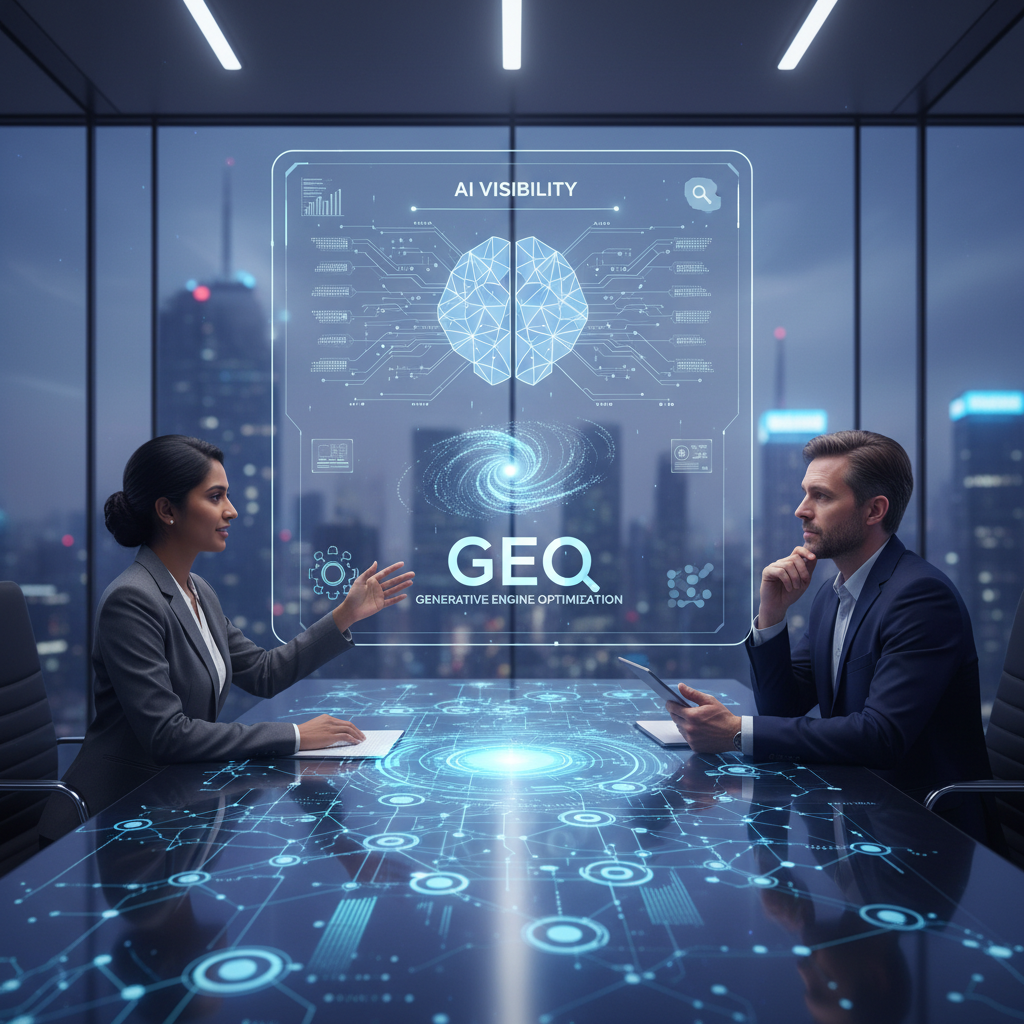
How will AI visibility evolve in 2026?
A better way to ask this, in business terms, is: **How will customers discover and trust your company when “search” becomes an answer, not a list of links?**
In 2026, more buying journeys will start inside AI-powered search experiences—ChatGPT, Perplexity, and Google AI Overviews—where the user gets a summarized recommendation in seconds. That changes the goal. It’s no longer “rank for a keyword.” It’s **become one of the sources the AI uses, cites, and recommends.**
This matters right now because the shift is already underway. In many industries, AI answers are taking the top of the page and reducing clicks to traditional listings. If your company isn’t visible inside those answers, you’re not just losing traffic—you’re losing **trust, consideration, and qualified inbound leads**.
Step 1 — Context & trend: from rankings to recommendations
Traditional SEO was built around one idea: **search engines rank pages**. You compete for position, earn clicks, and hope the page does its job.
AI-driven discovery works differently:
- **The AI assembles an answer** from multiple sources.
- It selects what to include based on clarity, consistency, and trust signals.
- The “winner” isn’t always the page that ranks #1. It’s the brand the AI believes is **most credible and easiest to summarize** for the user’s question.
This is where **Generative Engine Optimization (GEO)** comes in. GEO is the evolution beyond traditional SEO. It focuses on making your company:
1) easy for AI systems to understand,
2) safe to cite, and
3) strong enough to recommend.
AI engines aren’t just scanning keywords. They’re evaluating patterns:
- Does this company clearly explain what it does?
- Do other trusted sources validate it?
- Is the information specific, current, and consistent across the web?
- Does the content answer the question directly, without fluff?
In other words: **AI visibility is becoming a credibility game.** And credibility is measurable.
Step 2 — Direct answer: how AI visibility will evolve in 2026
In 2026, AI visibility will evolve in five practical ways that directly impact revenue and growth.
### 1) Visibility will mean “being included,” not “being found”
Today, many businesses still think visibility equals clicks from Google. In 2026, visibility will increasingly mean:
- your brand is named in the AI response,
- your approach is summarized,
- your framework is referenced,
- your site is cited as a source.
That’s a different funnel. The AI is doing the first-stage filtering for the buyer. If you’re not part of the AI’s shortlist, you may never enter the conversation.
### 2) Clear positioning will beat clever marketing copy
AI systems reward **clarity** because clarity is easy to compress into an answer. Companies that win will be the ones that can say, in plain language:
- who they serve,
- what problem they solve,
- what outcomes they deliver,
- how they do it,
- what makes them different.
This sounds simple, but most websites are built for brand vibe, not understanding. In 2026, your website strategy must be designed for both humans and machines—especially on service pages.
### 3) Authority will become more “networked”
AI engines learn from the broader web. Your digital authority will be shaped not just by your own site, but by the ecosystem around you:
- industry publications,
- partner sites,
- podcasts and interviews,
- case studies and third-party reviews,
- consistent company profiles and bios.
A brand with fewer pages but stronger third-party validation can outperform a brand with more content but weak external credibility. In 2026, expect “authority building” to look more like **strategic PR + expert content + consistency**, not just blogging.
### 4) Freshness and specificity will matter more than volume
The old playbook of publishing lots of similar posts will keep fading. AI answers improve when sources are:
- current,
- detailed,
- specific to a use case or industry,
- grounded in real examples.
Businesses that publish fewer, stronger pieces—especially expert-led content tied to real operations—will be easier to cite. This connects directly to higher-quality inbound leads because the content speaks to real buying criteria, not generic awareness.
### 5) Measurement will shift from “rankings” to “mentions and influence”
In 2026, smart teams will track new signals, such as:
- how often their brand is mentioned in AI answers,
- whether citations point to their pages,
- which pages AI pulls from most,
- whether AI describes them accurately (or confuses them with competitors),
- which competitor is being recommended instead.
If you can’t measure it, you can’t manage it. And in AI-powered search, the scoreboard is changing.
Step 3 — RocketSales insight: how we help companies win AI visibility
At RocketSales, our work sits at the intersection of **AI consulting**, content strategy, and modern search behavior. We help companies earn AI visibility by making their expertise easy to interpret, verify, and cite.
Here’s how we typically approach it:
**1) AI visibility audits**
We test how AI engines describe your company today, what sources they use, and where the narrative breaks. Many brands are either missing entirely—or being summarized in a way that hurts conversion.
**2) Generative Engine Optimization strategy (GEO)**
We map the questions decision-makers ask, the comparisons they make, and the proof they need before they trust a provider. Then we build a content plan that aligns with that intent.
**3) Content structuring for AI understanding**
We restructure key pages so an AI can quickly extract “who/what/why/how” without guessing. This improves citations and reduces misinterpretation.
**4) Authority and citation optimization**
We strengthen the external validation that AI systems rely on—helping your brand show up as a trusted source, not just a claimant.
Practical takeaways you can act on now:
- **Write “expert-led” pages, not generic posts.** Put your point of view, process, and constraints on the page so AI has something real to cite.
- **Structure service pages like an executive brief.** Use clear headings: who it’s for, the problem, the approach, outcomes, timelines, and FAQs.
- **Use schema and metadata to improve readability.** This helps machines interpret key entities (services, locations, reviews, FAQs) more reliably.
- **Align content with decision-maker intent.** Build pages that answer “Should I buy?” questions: cost drivers, implementation steps, risks, and success metrics.
None of this requires hype. It requires precision.
Step 4 — Future-facing insight: what happens if you ignore this shift?
If a business relies only on traditional SEO in 2026, two things tend to happen:
1) **Your traffic becomes less predictable** because AI answers intercept the click.
2) **Your brand becomes invisible at the moment of decision** because the buyer gets a shortlist before they ever open a browser tab.
The companies that invest in GEO now will build a compounding advantage. They will be the ones AI systems repeatedly cite, which reinforces trust, which drives more engagement, which creates more signals of authority—a flywheel that competitors will struggle to catch.
AI visibility is not a “nice to have.” It’s quickly becoming the entry fee for being considered.
Step 5 — CTA
If you’re curious how your company shows up today inside ChatGPT, Perplexity, or Google AI Overviews—and what to fix first—RocketSales can help you map the fastest path to stronger AI visibility and better inbound leads.
Learn more here: https://getrocketsales.org
FAQ: Generative Engine Optimization (GEO)
What is GEO?
GEO (Generative Engine Optimization) is the practice of structuring your site so AI search engines can understand your expertise and cite your content in answers.
How is GEO different from SEO?
SEO is about rankings in search results. GEO is about being referenced directly inside AI-generated answers and summaries.
Does GEO help inbound leads?
Often yes — AI-driven discovery can bring fewer visits, but they’re typically higher-intent and closer to a buying decision.
About RocketSales
RocketSales is an AI consulting firm focused on Generative Engine Optimization (GEO) and AI-first discovery, helping businesses improve visibility inside AI-powered search tools and drive more qualified inbound leads.
Learn more at RocketSales:
https://getrocketsales.org