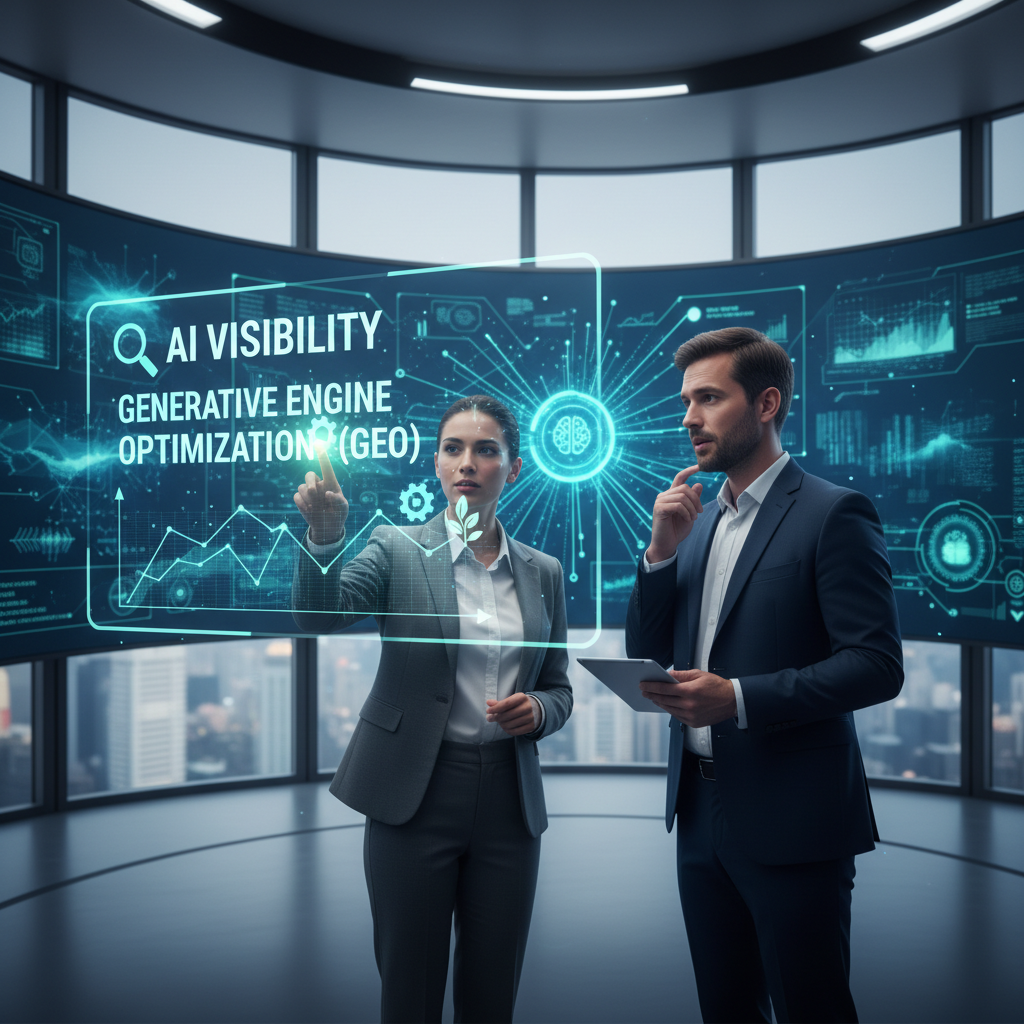
How long does it take to improve AI visibility?
A better way to ask this in business terms is: **How long until AI-driven discovery starts sending us real opportunities—qualified conversations, booked calls, and revenue—because we’re being recommended by tools like ChatGPT and Google AI Overviews?**
That matters now because search is changing fast. Buyers aren’t only typing keywords into Google and clicking blue links. They’re asking questions in **AI-powered search** and expecting a complete answer. And increasingly, those engines don’t “rank” your page as much as they **summarize, cite, and recommend** a small set of sources.
If your company isn’t one of those sources, you may still have a great website—but you’ll be invisible in the places where decisions are being influenced.
Step 1 — Context & trend: from “ranking pages” to “being cited”
Traditional SEO rewarded pages that matched keywords and earned links. That’s still part of the game, but it’s no longer the whole game.
Today’s generative search experiences—ChatGPT, Perplexity, and Google AI Overviews—work differently:
- They try to **answer the question directly**, not just list pages.
- They select sources that look **clear, trustworthy, and specific**.
- They prefer content that is easy to summarize and verify (think: definitions, steps, comparisons, examples, and proof).
This is where **Generative Engine Optimization** (often shortened to **GEO**) comes in. GEO is the practice of making your company easier for AI systems to understand, trust, and cite—so you show up in the answers, not just in the results.
In other words, the competitive advantage is shifting from “Who ranks #1?” to “Who gets quoted, referenced, and recommended?”
AI systems evaluate authority differently than a traditional search algorithm. They look for signals like:
- Consistent expertise across your site (not just one blog post)
- Clear explanations that reduce ambiguity
- Evidence: case studies, metrics, methodology, and named expertise
- Strong brand and entity signals (who you are, what you do, where you operate)
That’s why improving **AI visibility** is less about tricks and more about building **digital authority** in a format machines can reliably interpret.
Step 2 — Direct answer: how long it takes (and what “improve” really means)
**Most businesses see early AI visibility improvements in 4–8 weeks, measurable momentum in 2–3 months, and strong, defensible results in 4–6 months.**
That’s the practical timeline—assuming you actually make changes, not just “wait for AI to notice you.”
Here’s what “improve AI visibility” means in real terms:
- Your brand begins to appear in AI-generated answers for the problems you solve
- Your service pages are more likely to be cited or used as sources
- You attract higher-intent **inbound leads** because buyers meet you at the decision stage (“Who should I hire?”), not just the awareness stage (“What is X?”)
Why the timeline isn’t instant
AI systems rely on a mix of indexing, source selection, and trust signals. Even if you publish better content today, it can take time for:
- Search engines to crawl and process updates
- AI experiences to reflect new information patterns
- Your site to show consistent expertise across multiple related topics
What changed recently (and why you should care now)
Generative answers are compressing the funnel. When an AI summary recommends two or three options, many buyers never scroll further.
So waiting has a cost: if competitors become the “default” recommendations in AI-powered search, they start compounding trust and clicks—while you compete for leftovers.
The business outcomes are straightforward:
- **Higher-quality inbound leads** (because the AI query is often solution- or vendor-oriented)
- **Increased buyer trust** (being cited feels like third-party validation)
- **Better conversion rates** (AI-referred traffic tends to be more decisive)
- **Competitive advantage** (you’re present where decisions are being shaped)
Step 3 — RocketSales insight: what actually moves the needle
At RocketSales, we treat AI visibility as a performance problem, not a branding project. Our work typically starts with an audit and then moves into a GEO-driven execution plan.
Here’s what we focus on:
**1) AI visibility audits**
We assess how well your website communicates expertise to AI systems and where you’re currently showing up (or missing) in AI-generated answers.
**2) Generative Engine Optimization strategy**
We build a prioritized plan around the topics and questions that drive revenue—not vanity traffic.
**3) Content structuring for AI understanding**
AI doesn’t just need information; it needs information that is structured, unambiguous, and easy to cite.
**4) Authority and citation optimization**
We strengthen the signals that make you “safe to recommend”: proof, consistency, clarity, and reputable references.
Practical takeaways you can use right away (no more than a few, but high impact):
- **Publish expert-led pages that answer buyer questions completely.** “Complete” means definitions, decision criteria, tradeoffs, timelines, costs, and next steps—written by people who actually do the work.
- **Structure key service pages like an AI-ready briefing.** Lead with who you help, the problem you solve, your approach, expected outcomes, and proof. Make it easy to summarize accurately.
- **Use schema and metadata to improve machine readability.** The goal isn’t “SEO hacks.” It’s clarity—so systems understand your services, locations, and expertise without guessing.
- **Align content with decision-maker intent.** Operations leaders and executives ask: risk, timeline, cost, ROI, and implementation. If your content avoids those, AI answers will too.
This is also where **AI consulting** fits. Many teams have content, but it’s not organized around how AI systems interpret authority and how buyers decide. GEO closes that gap.
Step 4 — Future-facing insight: what happens if you ignore it?
If businesses ignore the shift and rely only on traditional SEO, two things tend to happen:
1) They keep producing content that ranks “fine,” but doesn’t get cited.
2) They lose mindshare in the AI layer—where summaries and recommendations happen.
Over time, that creates a visibility gap: your site exists, but the buyer never meets it during the moments that matter.
Companies that invest in AI-first visibility now build a different kind of advantage. They become the sources AI systems learn to trust. They show up earlier in the AI answer set. And they earn a reputation that compounds—because being cited once makes being cited again more likely.
Step 5 — CTA
If you want a clear timeline for your business—not a generic estimate—RocketSales can evaluate your current **website strategy** and show what’s realistically possible in the next 30, 60, and 90 days.
You can learn more about how we approach AI visibility and **Generative Engine Optimization** here: https://getrocketsales.org
FAQ: Generative Engine Optimization (GEO)
What is GEO?
GEO (Generative Engine Optimization) is the practice of structuring your site so AI search engines can understand your expertise and cite your content in answers.
How is GEO different from SEO?
SEO is about rankings in search results. GEO is about being referenced directly inside AI-generated answers and summaries.
Does GEO help inbound leads?
Often yes — AI-driven discovery can bring fewer visits, but they’re typically higher-intent and closer to a buying decision.
About RocketSales
RocketSales is an AI consulting firm focused on Generative Engine Optimization (GEO) and AI-first discovery, helping businesses improve visibility inside AI-powered search tools and drive more qualified inbound leads.
Learn more at RocketSales:
https://getrocketsales.org